

I arrived in Amsterdam and I noticed how every time I ordered water at a restaurant they brought it in a warm cup, not a bottle, not a pitcher, just a normal cup. I am a person who is highly considerate when it comes to water. Because in many countries safe drinking water is often treated as a given. We drink it every day without thinking much about where it comes from, how it’s treated, or what happens to it before it reaches our glass. But that’s not me. I HAVE to know what is exactly in my water. Some heavy metals? Mineral content? Maybe some leftover pharmaceuticals? 🙂
That assumption is exactly what pushed me to look closer at Amsterdam’s tap water. Not because something felt wrong, but because “safe to drink” is a phrase that usually ends the conversation. I wanted to understand what actually sits behind it in real terms, not just reputation.
Where Amsterdam’s Drinking Water Comes From and Why That Matters
As a first step toward finding exactly what’s in my water, first we have to start at the source. Amsterdam’s drinking water comes mainly from surface water, especially large rivers like the Rhine, with some contribution from groundwater depending on location.
Surface water comes with predictable challenges:
- Suspended particles like sand or clay
- Organic matter such as algae
- Dissolved substances like salts and metals
- Microorganisms and pathogens
- And more
Groundwater comes with its own set of problems but by contrast, it may be considered slightly better as it is being naturally filtered as it moves through soil and rock. That filtration removes many particles and organisms, but it often increases mineral content, which leads to harder water (if the rocks that the water is passing through contain calcium & Magnesum.
How Amsterdam Treats Its Drinking Water
Alright, so that water coming out from my tap is the “better” option or…? That question came very naturally to Dr. James from Pollet Water Group during our interview at Aquatech water conference. I just had to know more about the treatment process. So he said just like in most countries, no one drinks water directly from a river or ground source. All of Amsterdam’s drinking water goes through water treatment facilities designed to meet strict EU standards.
These facilities get the water from the mentioned sources, remove particles, reduce microorganisms, and manage mineral levels. The Netherlands also invests heavily in protecting its source water, which plays a big role in maintaining quality.
This is a major reason Amsterdam’s tap water has such a strong reputation about the high quality of the tap water.
But treatment does not mean the water is pure, it still has some things in it but of course the levels of the contaminants are considered safe for human consumption.

What Happens Between the Treatment Plant and Your Tap
At this point, I told myself, that’s good, just gotta check that list of contaminants.
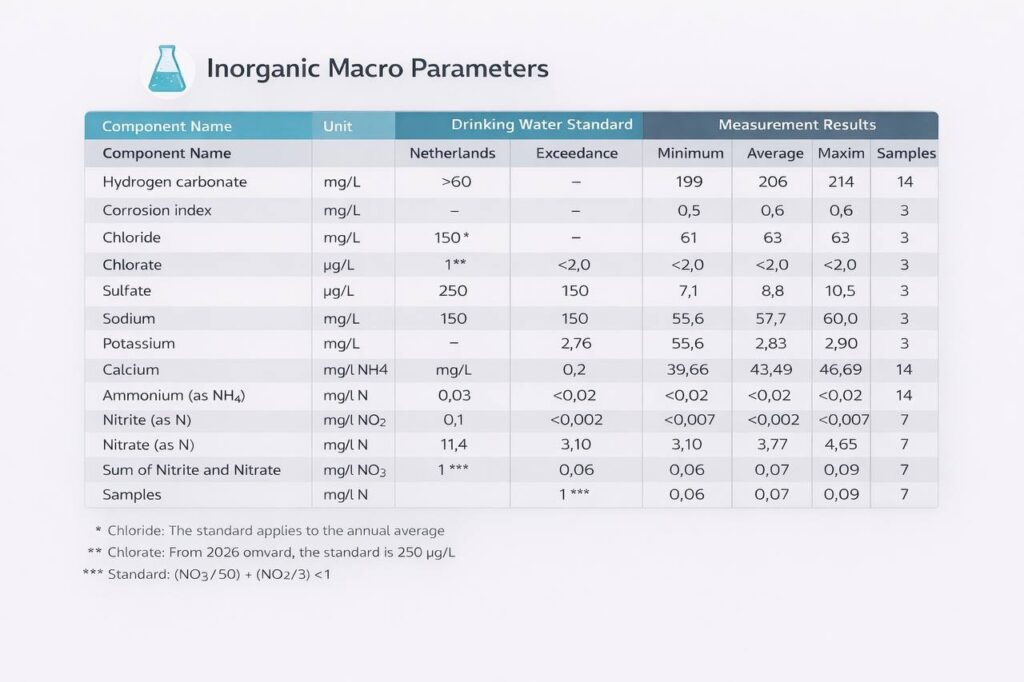
Here’s a breakdown of the main inorganic minerals measured in the drinking water, compared with Dutch drinking water. Many more substances are tested as well, you can find the full overview here
Once water leaves the treatment facility, its journey isn’t over. It still travels through kilometers of pipes, storage systems, and building infrastructure before it reaches your glass. Along the way, it comes into contact with many materials that can influence its final quality.
Because water is highly absorbent, it can pick up substances from old pipes or other internal plumbing issues. This doesn’t mean Amsterdam’s water is unsafe, but it helps explain why water quality at the tap can sometimes differ from water quality at the treatment plant, especially in older buildings.
Tip: If you live in an older apartment or notice inconsistent taste or scaling, it’s highly recommended testing your tap water or adding an extra layer of filtration for peace of mind.
Why Clear Tap Water Doesn’t Always Mean Clean Water
Soooo many things in the water but it just looks so clear, how can that be? This is something I’ve already discussed in my previous blog, because it comes up again and again when we talk about drinking water quality.
One of the most common assumptions is that clear water must be clean water. If it looks fine, smells fine, and tastes fine, it feels safe to drink. But many substances that affect drinking water quality are completely invisible. Dissolved solids, certain metals, and chemical compounds don’t change how water looks, smells, or even tastes.
That’s why water quality can’t be judged by appearance alone. It’s determined by how water is treated, tested, and monitored not by how reassuring it looks in a glass.
PFAS in the Netherlands: Expert Opinion
A prime example of something that doesn’t have a color, smell or feel to it is the new emerging chemical that apparently causes so many health problems. As I dug deeper into Amsterdam’s water quality, one topic kept coming up in conversations with water professionals: PFAS, often called “forever chemicals.”
At a water conference Aquatech Amsterdam, I spoke with Pieter Spillebeen from Pollet Water Group (PWG) and James Joseph, an R&D manager, and Bilal Ozturk, who works on residential water treatment solutions. All the experts highlighted the same challenge: PFAS isn’t one chemical, but a large group of man-made substances that are extremely difficult to break down in the environment and the human body.
PFAS are widely used in products like non-stick cookware, waterproof clothing, food packaging, and industrial materials. Because of that, traces of this chemical have been detected in water sources across Europe, including the Netherlands. As the experts explained, PFAS is considered an emerging contaminant, which means research and regulations are still catching up.
Most treatment plants were not originally designed to remove PFAS. That doesn’t mean Amsterdam’s tap water is unsafe but it does explain why water quality standards and treatment approaches are now evolving. But if you check the list of the regulated contaminants, you’ll find PFAS there, it exists, they are monitoring it, thank God! But wait… the amount is not zero, it is still accepted that some traces of this may be found in your tap water. Did I mention that I’m picky with my water? Ya so I need my water to be fully clean/pure. It was only natural to switch the dialogue to find solutions to this PFAS in water problem.
Can Reverse Osmosis Remove PFAS and Other Contaminants?
As a pioneer of reverse osmosis water treatment, I couldn’t resist asking this question directly. When I spoke with water treatment experts, one technology kept coming up again and again: reverse osmosis (RO).
So what are RO systems? In short, Reverse osmosis systems work by pushing water through a semi-permeable membrane that blocks extremely small particles. This allows them to remove up to 99% of many known contaminants, including PFAS, heavy metals, and dissolved solids that conventional treatment methods don’t always address.
What makes RO particularly relevant today is that it doesn’t depend on identifying a single contaminant. Instead, it removes a wide spectrum of substances based on physical properties like size and charge. That’s why experts often describe RO as more future-proof, it can handle contaminants we already know about, as well as those that may emerge later.
Because RO also removes naturally occurring minerals, many systems add them back afterward to improve taste. From a nutritional perspective, this isn’t a concern, since essential minerals come mainly from food rather than drinking water. But at least I know that RO systems effectively remove all PFAS traces from my water.
What My Water Tests in Amsterdam Showed
To get closer to my answer of what’s exactly in my water, I took things a step further. I brought some tap water back with me from Amsterdam and ran a few basic DIY tests. I’ve done similar tests during my travels before, so this was mainly about getting a practical snapshot, not chasing perfect lab results.
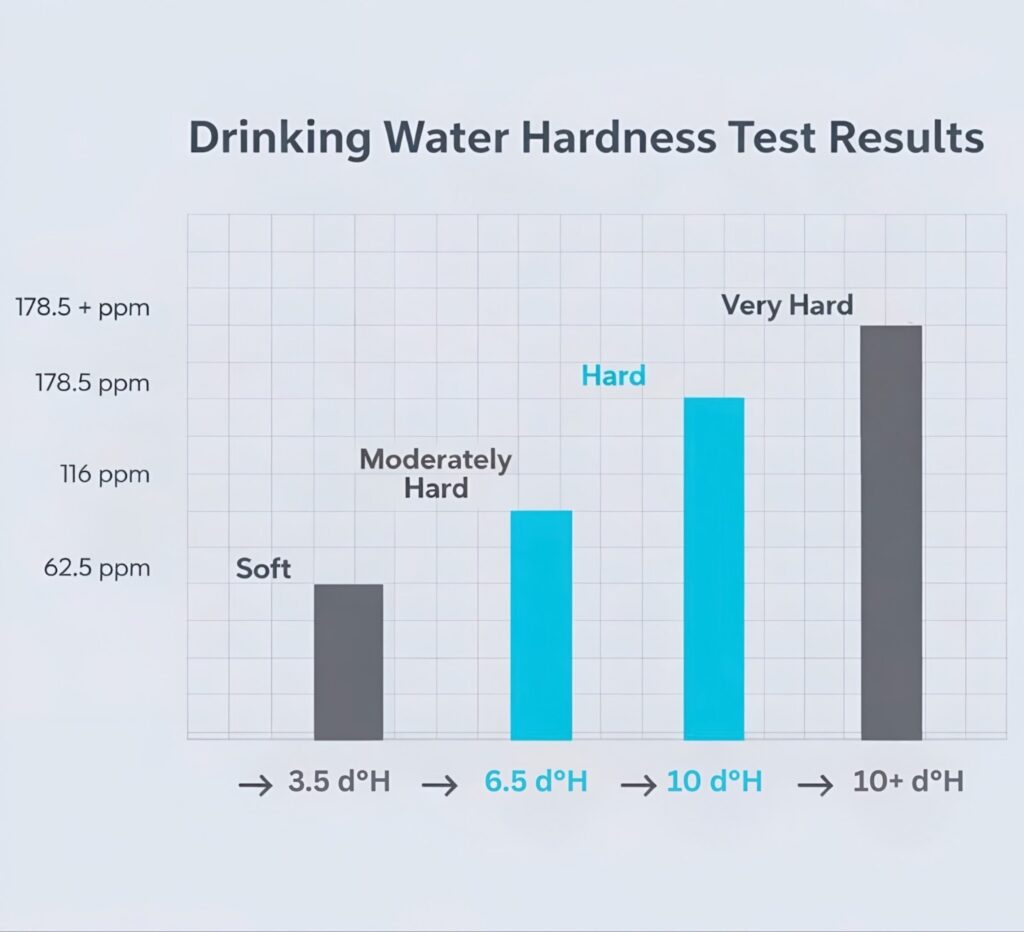
The sample was taken from the airport of Schipol and the results were mostly reassuring:
• no detectable iron
• general parameters within acceptable ranges
• hard water, which helps explain scaling on appliances
Final Thoughts: What This Investigation Changed for Me
So what is in the water that I’m drinking? Turns out, many things with moderation. Although, I don’t think about drinking water with fear. I think about it with context. Filtering water isn’t about rejecting public systems. It’s about adding a layer of control in a system that spans rivers, pipes, and decades-old infrastructure. Amsterdam deserves its reputation for good water but good water doesn’t mean unquestionable water. Understanding how it works turns trust into informed confidence and that’s what this investigation was really about.
To become a part of my trip and investigation, watch my full video
Summary:
- Amsterdam’s tap water is considered safe to drink and meets strict EU standards
- Most of the city’s water comes from surface sources and is heavily treated
- Water quality can still change between the treatment plant and your home tap
- Clear water doesn’t automatically mean clean water
- PFAS is an emerging issue across Europe, including the Netherlands
- Reverse osmosis is the most effective ways to remove a wide range of known and unknown contaminants
- Home filtration isn’t about fear, it’s about knowing and controlling.
Do’s and Don’ts for Drinking Tap Water in Amsterdam
Do: Trust the public system, Amsterdam has strong water infrastructure.
Don’t: Assume clear water means nothing else is present.
Do: Test for lead if you live in an older apartment.
Don’t: Think water quality is the same everywhere in the city
Do: Use filtration if you want added consistency or peace of mind
Don’t: Rely on taste alone to judge water quality
FAQ
Why do people trust Amsterdam’s tap water so much?
The Netherlands has invested heavily in water infrastructure and source protection for decades. Because major water issues are rare and standards are strict, trust has built up over time. That trust is largely justified, but it can also mean people stop thinking about what happens after the water leaves the treatment plant. Best is to get it checked or watch a crash course here: add YT link.
Can tap water quality vary from one Amsterdam neighborhood to another?
Yes. While the treated water leaving the facility meets the same standards, conditions can vary depending on pipe age, building plumbing, and local infrastructure. That’s why water can behave slightly differently from one apartment to another. That’s not only in Amsterdam, it’s everywhere.
Why is water quality discussed more now than before?
In short, PFAS. In long, because new substances are being detected and studied. Water systems were designed around what we knew decades ago. As science evolves, so does our understanding of what should be monitored and how water should be treated. Lately, the topic has been about the forever chemical (PFAS).While EU and EPA have already incorporated this into regulating it, the rest of the world is still catching up.
Is bottled water safer than tap water in Amsterdam?
Not necessarily. Amsterdam’s tap water is highly regulated, while bottled water quality depends on the source, bottling process, and storage conditions. Bottled water isn’t automatically cleaner, it’s just packaged differently. All you need to know is that huge water treatment facilities are obligated to monitor a very very long list of contaminants while the bottled industry isn’t as heavily regulated.
Does boiling tap water improve its quality?
Boiling kills bacteria, but it doesn’t remove dissolved substances, metals, or chemicals. In some cases, boiling can even concentrate them. If we’re looking at the amount of bacteria found in the water, then yes, it will improve the amount of it, so it’s useful in specific situations, but it’s not a complete solution.
Why do experts talk about “long-term exposure” instead of immediate risk?
Because many water-related concerns aren’t about short-term illness. They’re about repeated, low-level exposure over time. That’s why filtration and testing are often framed as preventive measures rather than emergency responses.
Is it necessary to test tap water regularly?
Depends. If you’re using unregulated groundwater then you absolutely have to. But for most people, routine testing isn’t necessary as local water treatment facilities are already doing that. But testing can be helpful in older buildings, after plumbing work, or if you notice changes in taste, color, or scaling. It’s a way to understand your specific situation, not a requirement for everyone.
Why does filtration come down to personal choice?
Because water quality isn’t just about meeting standards, it’s about consistency, comfort, and what level of control you’re comfortable with. Two people can look at the same water and make different, reasonable choices.